A Textual Research on the Historical Remains of Xianggong Temple, Yu Family Well, Wannian Ancient Well, Wuzhen Street and Huanghua Street in Shaoguan
1. Introduction
Shaoguan is the hometown of Yu Jing (posthumously titled Xianggong), a distinguished minister of the Northern Song Dynasty. A wealth of historical and cultural relics related to Yu Jing have been preserved in the city since the Song Dynasty. Centered on Xianggong Temple, a cluster of cultural landmarks including Yu Family Well, Wannian Ancient Well, Wuzhen Street and Huanghua Street have formed the core of Yu clan culture in urban Shaoguan since the Qing Dynasty. Based on the ancestral hall site records in the Yu Clan Genealogy of the Qing Dynasty, combined with historical documents, field investigations and local evolution records, this paper conducts a systematic textual research on the evolution, geographical location and historical value of Xianggong Temple and its surrounding relics, clarifying their millennium-long inheritance and cultural connotations.
2. Textual Research on the Site and Architectural Layout of Xianggong Temple
2.1 Location and Overall Layout
According to the ancestral hall site map recorded in the Qing-Dynasty Yu Clan Genealogy, Xianggong Temple is situated beside Wuzhen Street. It adjoins the main Wuzhen Street to the north, Huanghua Street to the west, Yu clan estates to the east, and Yu Family Well to the south, forming a well-structured pattern of “ancestral hall in the center, surrounded by ancient streets”. The main building follows the traditional ritual layout of ancient Chinese memorial halls, consisting of a spirit tower, a worship hall, a courtyard and a screen wall. Detailed dimensional records are preserved: the spirit tower is 2.9 zhang deep, the worship hall 2.5 zhang deep, the courtyard 2.4 zhang wide, the screen wall 7.6 chi deep, and the left and right corridors 4.5 chi wide each. The standardized layout strictly complies with the construction rituals of minister-level memorial halls since the Song Dynasty.
The genealogy clearly documents the precise boundaries of the temple site: bordering a 5.5-chi-wide lane behind Yu Clan Lane to the east, Tan’s residence and the former Xianggong site to the west, Wuzhen Street to the north, and the boundary of Baisha Stele to the south. The clear territorial and property records serve as the most direct physical literature for verifying the site of Xianggong Temple in the Qing Dynasty.
2.2 Evolution and Renovation History
First built in the Song Dynasty, Xianggong Temple was a special shrine for local officials and civilians to worship Yu Jing, with successive renovations in subsequent dynasties. It was renovated again during the Daoguang reign of the Qing Dynasty, and its complete layout and location were recorded in the clan genealogy. Despite centuries of vicissitudes, the core scope of the temple site has never shifted, maintaining consistent cultural inheritance with the long-preserved tomb of Yu Jing. Inscriptions such as “Xianggong Site” and “Stele Record of Reconstructing Zhongxiangong Temple” in the genealogy confirm that this location has been a core sacred site for Yu clan ancestor worship since the Song Dynasty, as well as one of the few verifiable Song-Dynasty minister shrine relics in urban Shaoguan.
3. Textual Research on Surrounding Historical Relics
3.1 Yu Family Well and Wannian Ancient Well
The genealogy site map marks Yu Family Well to the south of Xianggong Temple and Wannian Ancient Well to the east. Since the Song Dynasty, the two ancient wells have served as vital water sources for the Yu clan and local residents, standing as physical witnesses of regional place name evolution and clan settlement history.
Located at the southeast corner of the temple site and engraved with the “Zeng Sansheng Stele”, Yu Family Well was exclusively used by Yu clan members in ancient times. Coexisting with Xianggong Temple for centuries, it witnesses the settlement of the Yu clan in the Wuzhen Street area since the Song Dynasty.
Situated to the east of the former Yu clan residences, Wannian Ancient Well was a public water source for local streets. It has been in continuous use since the Song Dynasty. As a well-preserved Qing-Dynasty well relic in old Shaoguan, it is a key humanistic landmark sustaining the historical pattern of Wuzhen Street.
3.2 Wuzhen Street and Huanghua Street
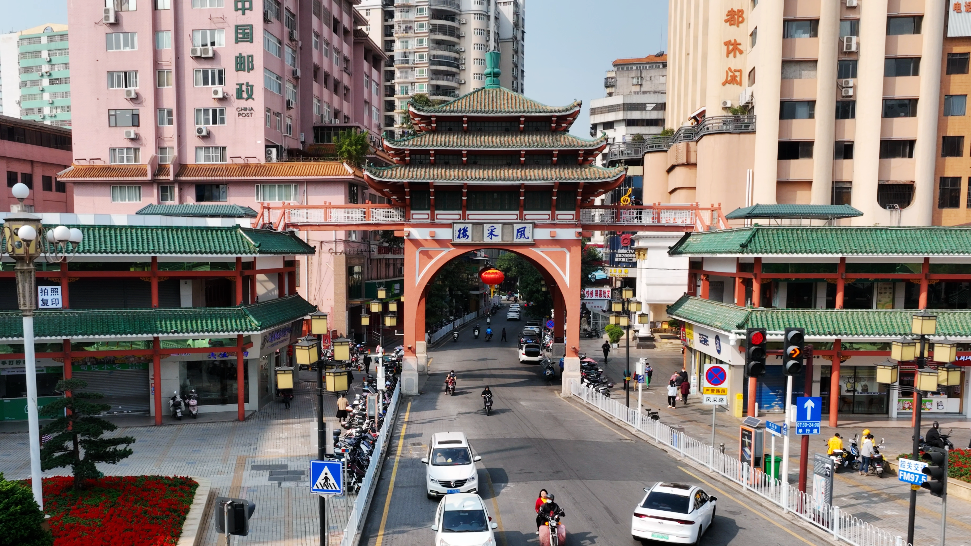
Lying to the north of Xianggong Temple, Wuzhen Street was a major thoroughfare in western Shaoguan during the Qing Dynasty. The temple’s frontage location reflects the respect and admiration for Yu Jing’s remarkable achievements from generation to generation, forming an integrated cultural landscape of ancient shrine and old street dating back to the Song Dynasty. The name “Wuzhen”, literally meaning “military stabilization”, symbolizes local peace and stability, and echoes Shaoguan’s strategic status as a key military and cultural hub in northern Guangdong since the Song Dynasty.
Located to the west of Xianggong Temple and connected with Wuzhen Street, Huanghua Street was an important ancient passage in western urban Shaoguan. Its name derives from The Book of Songs·Minor Odes, an ancient classic honoring envoys’ noble missions. The name perfectly echoes Yu Jing’s distinguished feat of being dispatched three times to the Khitan regime to safeguard national stability, embodying the folk commemoration of his outstanding contributions.
4. Evidence from Historical Documents and Field Investigations
The site map in the Qing-Dynasty Yu Clan Genealogy precisely records the location, dimensions and boundaries of Xianggong Temple, ancient wells and surrounding streets. The mutually verified texts and illustrations serve as the most valuable first-hand literature for this research. Combined with local historical records and urban street evolution data, it fully validates the historical status and cultural inheritance of these relics since the Song Dynasty.
Around 1993, Yu Xinxing conducted an on-site investigation of the former Xianggong Temple site with his son Yu Yang. At that time, the old residential buildings of the Yu clan were under demolition, yet the temple site remained identifiable. Six to eight stone steles and stone lion carvings were still discovered on site. This firsthand field evidence provides authentic and credible support for the location verification and historical evolution of Xianggong Temple since the Song Dynasty.
5. Conclusion
Xianggong Temple, Yu Family Well, Wannian Ancient Well, Wuzhen Street and Huanghua Street are not isolated historical place names. Instead, they form an integrated cultural complex of ancient shrines, wells and streets centered on Yu Jing’s culture, with a continuous history dating back to the Song Dynasty. Verified by detailed genealogical records, local historical context and on-site physical relics, this cultural cluster boasts a well-preserved spatial pattern and profound cultural heritage spanning a millennium. These relics vividly record the changes of old Shaoguan’s urban streets and carry forward Yu Jing’s spiritual legacy among local people for generations. They also provide valuable historical and cultural references for the research of clan culture, ancient shrine architecture and urban geographical evolution in northern Guangdong.
The millennium cultural vein of Shaoguan thrives through the inheritance of ancient sages’ virtues. From the contemporary promotion of celebrity culture to the long-standing preservation of urban historical relics, Shaoguan’s profound humanity is embedded in its ancient streets, shrines and wells. This special cultural filming and academic textual research has unveiled the hidden charm of local historical relics and revitalized the noble spirit of Zhang Jiuling and Yu Jing in the new era. It enables the profound traditional Lingnan culture to endure and flourish in Shaoguan from generation to generation.

 手机版
手机版